
Mount Kenya Conservation Forum

The flora found on Mount Kenya varies with altitude. As the altitude increases, the plants have to be more specialized, with adaptations to strong sunlight with ultraviolet, lower mean temperatures and freezing night temperatures.
Plants in the Afro-alpine zone have overcome these difficulties in several ways. One adaptation is known as the giant rosette, which is exhibited by giant senecio, giant lobelia and giant thistle, which use bud leaves to protect their buds from freezing.
Giant rosette senecios form single-aged stands that drive community structure over decades. Many plant species in the Afro-alpine zone of Mount Kenya are giant versions of lowland (or temperate) relatives.
Above the forest is a belt of bamboo zone.
Above the bamboo is the timberline forest.
The trees here are often smaller than the trees in the forests lower down the mountain. When the trees can no longer grow, the vegetation changes into heath land and chaparral, at around 3,000 m (9,800 ft). Heath land is found in the wetter areas, on the west side of Mount Kenya, and is dominated by giant heathers. Chaparral is found in the drier areas and grasses are more common.
Mt. Kenya is endowed with a rich natural resource base including a variety of wild animals like elephants, buffalos, bongos, tree and rock hyrax, white tailed mongoose, suni, black fronted duiker, mole rat, bushbucks, porcupines, giant forest hogs, bush pigs, water buck and Elands.
Various species of monkeys and especially the white and black Colubus monkey are also common. Predators found here include hyena and leopard, and occasionally lion.
Over 130 bird species have been recorded on Mt. Kenya.

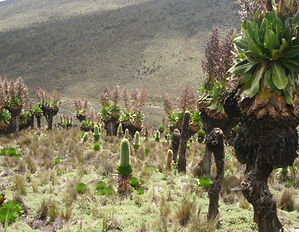
Flora
Fauna
Mount Kenya is a home for wildlife and rich biodiversity